How Local Service Businesses Win the Map Pack in 2026
 Local SEO
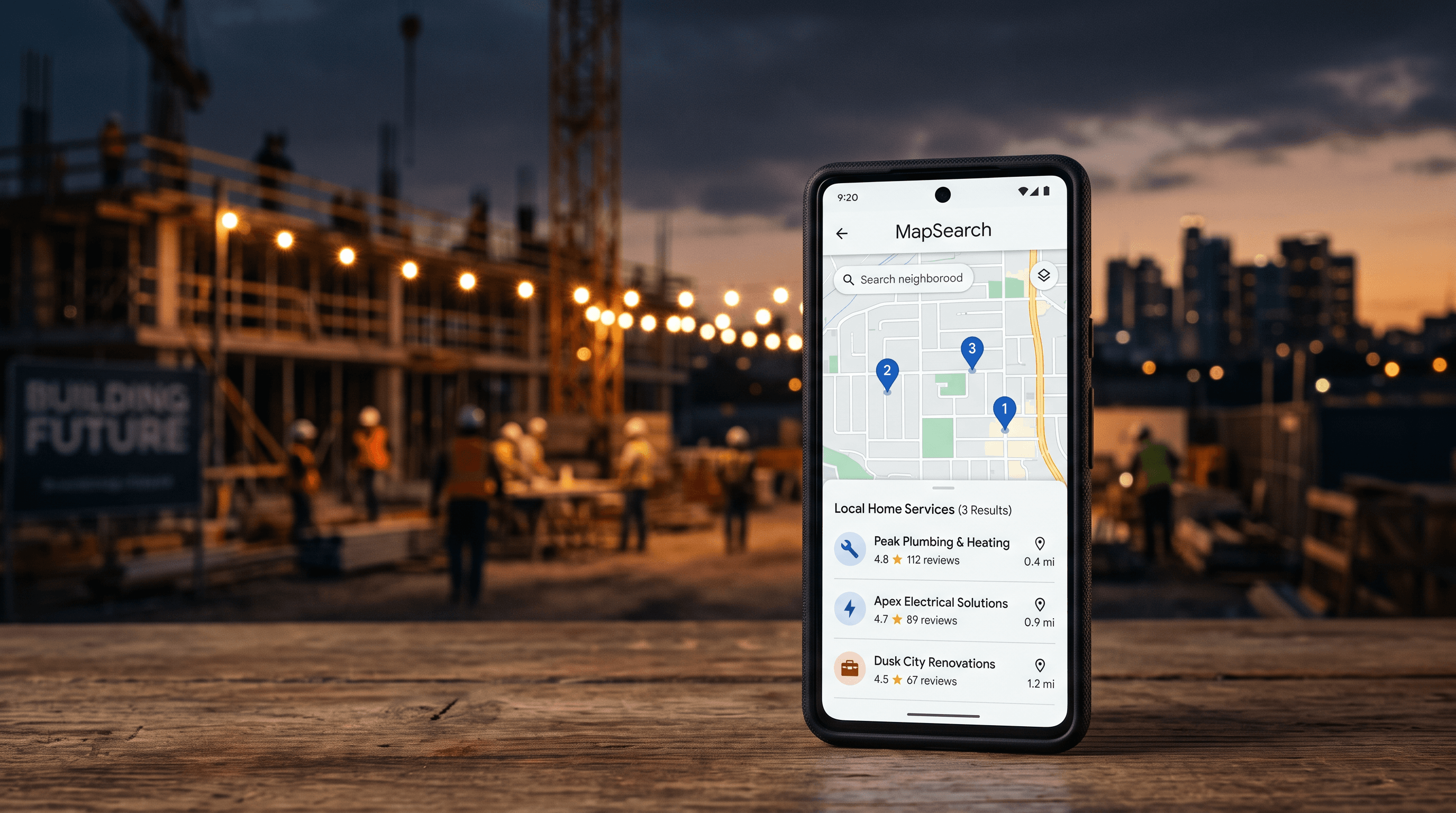
Most owners think ranking well on Google is about keywords on their website. It isn't, and it hasn't been for years. The map pack, those three listings with a map that appear above the regular search results when someone searches "plumber near me" or "general contractor [city]," runs on an entirely different set of ranking signals than the organic results underneath it, and for local service and construction businesses, it's the block of search results that actually sends the calls.
If you've ever wondered why a competitor with a worse website consistently outranks you, the answer almost never lives on their website. It lives on their Google Business Profile, and it's rarely something they're even actively thinking about. It's just been set up correctly, and yours probably hasn't.
What Actually Moves the Needle in the Map Pack
Three signals carry almost all of the ranking weight, and none of them are "better website copy":
- Proximity. Distance from the searcher to your listed address is a major factor you cannot out-optimize with content. What you can do is legitimately open a second service-area listing if you genuinely serve that area, which is one of the few proximity levers actually within your control.
- Review velocity. Not just star rating, but how consistently new reviews are coming in. Google watches this closely: a business earning one review a month reads as smaller or less active than one earning ten, even at the identical average star rating, and that difference shows up directly in ranking position.
- Category accuracy. This is the one we find broken most often. Roughly half of the roofing and construction companies we onboard are filed under a generic category like "General Contractor" instead of the specific category Google actually rewards visibility for, like "Roofing Contractor" or "Kitchen Remodeler." That's a real, measurable ranking cost, not a cosmetic detail, and it's often the single easiest fix available on a client's entire profile.
Why Most Local SEO Advice Online Is Outdated
A lot of what's still circulating about local SEO was true five years ago and isn't anymore. Keyword-stuffing your business name, building generic backlinks, and publishing thin blog posts stuffed with city names all carry far less weight in 2026 than they used to, and some of it actively risks a suspension if Google flags it as manipulative. What's replaced it is simpler and harder to fake: consistent, verifiable proof that a real, active business is doing real work in a real service area, expressed through reviews, photos, categories, and profile completeness.
That shift is good news for legitimate local businesses and bad news for anyone hoping to shortcut it. There is no longer a trick that outranks an accurate, active, well-reviewed profile.
The 90-Day Local SEO Play We Run for Every Client
Week one. We audit your Google Business Profile against every field Google actually weighs: primary and secondary categories, service areas, business attributes, and photo count and recency, including whether photos carry real job-site metadata instead of generic stock imagery. Most of this audit and cleanup takes a week, not a quarter, because the fixes themselves are usually fast. Finding exactly what's broken is the part that takes expertise.
Weeks two through four. Review requests go out systematically, timed to the actual close of each job rather than a bulk monthly blast that gets ignored or feels impersonal. This is also when we start correcting any category or service-area misconfigurations found in week one.
Days 30 through 90. Review velocity and category corrections start compounding into visible ranking movement. By day 90, you're not hoping for the map pack. You're watching your position move because the underlying signals moved first, and you can point to exactly which ones.
The Part Nobody Tells You
None of this replaces a good website. It amplifies one. A business with a sharp, fast website and a weak Google Business Profile still loses map pack visibility to a mediocre website backed by a strong, active profile, because the map pack ranks the profile itself, not your homepage. But a strong profile sending calls to a slow, unconvincing website wastes a meaningful share of the traffic that hard-won ranking earns you.
Fix both, in the right order, and the compounding is where the real growth shows up: a Google Business Profile that consistently earns map pack visibility, sending calls to a website that actually converts them into booked jobs.
Frequently Asked
What is the map pack and why does it matter more than regular search rankings?
The map pack is the block of three business listings with a map that appears above regular organic search results for local searches like 'plumber near me' or 'roofing company [city].' For local service and construction businesses, it captures the majority of clicks on a local search, often more than the entire organic results list combined, which is why ranking there matters more than a generic page-one ranking.
How long does it take to rank in the map pack?
The Google Business Profile audit and cleanup itself takes about a week. Meaningful movement in map pack position typically shows up within 60 to 90 days, once review velocity, category accuracy, and proximity signals have had time to compound, which is also why a 90-day window is how we structure every new engagement.
Can I rank in the map pack in multiple cities if I only have one office?
Yes, if you legitimately and verifiably serve those additional cities, through a properly configured service area business profile rather than a fake second address, which Google actively penalizes when discovered. This is one of the fastest legitimate ways to expand map pack visibility for a business that already serves a wider region than its listed address suggests.
What matters more: my website or my Google Business Profile?
Neither replaces the other. A sharp website with a weak, poorly categorized Google Business Profile still loses map pack visibility to a mediocre website with a strong, active profile, because the map pack ranks the profile, not the website. But a strong profile sending calls to a slow, unconvincing website wastes a large share of that visibility. Fix both, in that order, for the compounding effect.
Want results like these for your business?
Twenty minutes, zero pressure. Leave with a plan either way.